Showing posts with label afghanistan. Show all posts

Monday, May 25, 2009

A small dog in Kabul

“Chuche (pronounced choochei) Sag” was how we all called him – Dari for “small dog”. He was about 6 months old, born on our street to another street dog. He had a few more litter mates that scattered, and Chuche Sag was left by himself, to find his position in the hierarchy within the gang of dogs that patrol our street.


I never knew him. I have my own dog, and there are two others that I regularly feed – a whole another story. I always saw him, a bit of a loner having no companions his age, with the same street smart attitude of other young street dogs.


A few days ago, a horrific sight waited for us as we walked escorted by our armed guards to our office. One of Chuche Sag’s front legs was viciously damaged. The entire skin had rolled down like a stocking, pooling by his paws. The bloodied muscle was exposed, and it was clear that his leg was badly broken. Something had hit him – a car or a motorcycle, but did not kill him.


He limped on three legs, and after two days did not move much. My friend and co-worker Fiona begged me to do something. I was at a loss – he was a street dog and afraid enough of people to bite, and I did not want to be bitten. I called Tigger House, the only animal shelter in Kabul, but the doctor was not in. When I finally got in touch, my Dari was not good enough, his English was not good enough, and I could not explain my need.


So, then we started feeding him – leaving bowls of food a few feet away from him. He always hunkered in the culverts, just out of reach. However, a few hours later, the food would be gone. Two days went by in this attempt to draw him out, so that we could nab him and take him to the vet.


On Saturday, about five days later, I went over to the vet and said that I would pay for him to come with me and capture this dog. He readily agreed, and we came back to the house, but the dog was nowhere to be found. By this time, a whole lot of people had gotten involved to save this dog, and some of the guards went out on motorcycles to find the dog – no dog to be found. The doctor left a slim leash and gloves and taught a towering guard how to capture the dog, should we find it, and then to call him.


On the sixth day, we spotted him, and the towering guard, captured him and we had him leashed. He screamed in fright and pain, and finally curled himself into a ball and gave up the fight. I called the office and told them what was going on and to send a driver to Tigger House. The driver, left his breakfast unfinished, and rushed to get the doctor. The doctor came with a kennel, came over to see Chuche Sag, and said, “this does not look good, we may have to put him to sleep”.


By this time Chuche Sag was completely terrified, and with barely a whimper allowed himself to be pushed into the kennel and driven to the hospital. A few hours later, a doctor with perfect English called and gave the bad news – the entire leg is smashed and not just broken, the skin is gone and cannot be stitched to save it, infection has set into the bone and has most likely spread. The dog is in extreme pain. Even in the US, most vets would recommend either amputation or euthanasia.


Dogs have difficult lives in Afghanistan, and a three legged small puppy will not have a chance. In any case, Tigger House was not set up for amputations, or for the intense care required for recovery. He asked for my permission to put him to sleep and I agreed. Within the next hour he was gone and buried.


I am writing this article to mourn him and to talk about him. I feel that somehow he should be remembered in a tangible manner, and not just lost. I have no pictures of him. It was so cute to watch him grow up and make his way. It was so humbling to see this little thing silently and bravely deal with his injury. It was so heartbreaking to see him slide farther and farther into a lonely place, as he crept along in culverts all alone hoping that somehow food will be available.


It is extreme irony that while in health he had so many reasons to fear the species we call “human”, that when he finally was surrounded by people who wanted to help him, it was simply too late.


I just want you to know that you are mourned and that you are remembered. All the guards shook their heads sadly at the news – they were rooting for you. Haris, the driver who sped to the hospital to get the doctor, upon hearing the final decision, cursed the driver who dealt you the fatal blow. You were Fiona’s favorite dog, and she regrets not having taken you in when you were very, very little, and she mourns you.


Be in peace.

Thursday, March 26, 2009

Really? Pakistan is the Most Dangerous Country in the World?


“Iraq for Sale – The War Profiteers”, “Wal-Mart: The High Cost of Low Price”, “Outfoxed: Rupert Murdoch’s War on Journalism”Robert Greenwald and his company Brave New Films do impressive work, and I have counted myself as a fan. And as such, today it is with great reluctance that I question his approach for his newest endeavor: “Rethink Afghanistan”.

A friend e-mailed me about this and I immediately dug in, and found this headline, “Pakistan, the Most Dangerous Country in the World”. There were a couple of video trailers of various scholars, diplomats, military folks who gave sound bites about how no one should rattle this country, and how the fate of Afghanistan and Pakistan are inextricably linked.

I am an east-Indian and routinely have to remind myself that there are real people living in Pakistan and not monsters, since as a child of parents who barely survived the partition, I’ve been genetically programmed to be hostile to this country. And even I was rattled. Why is that we are outraged when President Bush declares a few countries to be the axis-of-evil, and yet when a progressive declares a country to be the “Most Dangerous Country in the World”, we remain silent? We even might start thinking, wow, this must be truth.

As Mr. Greenwald investigates and rethinks Afghanistan, I want to urge him to consider the following in his new documentary. I want him to challenge his viewers to ponder this question:
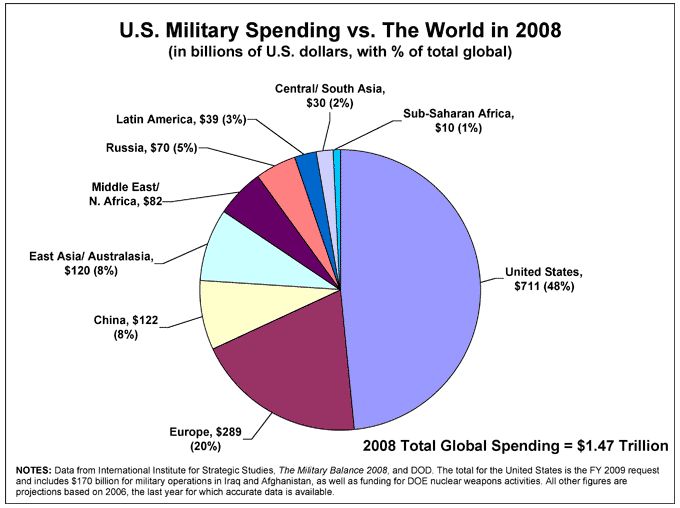
“When the United States of America spends more on manufacturing killing paraphernalia than the rest of the world combined, could it be that we are the most dangerous country in the world”?

To make sure that people really understood, he could use the following image to show how our defense spending is almost MORE THAN THE REST OF THE WORLD COMBINED. (Link Here to see the picture below more clearly)


I would like him to investigate this question: Since in the above pie chart Pakistan is not even a sliver, and yet it is awash in arms, where are those arms coming from? Could they be from the five members of the U.N. Security Council, who together manufacture 80 percent of the world’s arms? Does that not beg the question: Are the five members of the Security Council the most dangerous countries in the world?

Mogadeshu, Dafur, Pakistan, Afghanistan, Iraq – all countries in heavy conflict and heavily armed. Where are these arms coming from?

Why is it that our drug policy is to spend billions to try and stop the supply and not the demand, but when it comes to our arms policy it is not applicable?

Please consider the following facts:

Since 1992, the United States has exported more than $142 billion dollars worth of weaponry to states around the world.[1] The U.S. dominates this international arms market, supplying just under half of all arms exports in 2001, roughly two and a half times more than the second and third largest suppliers. [2 ] U.S. weapons sales help outfit non-democratic regimes, soldiers who commit gross human rights abuses against their citizens and citizens of other countries, and forces in unstable regions on the verge of, in the middle of, or recovering from conflict.

The United States military has had to face troops previously trained by its own military or supplied with U.S. weaponry in Panama, Iraq, Somalia, Haiti, and now in Afghanistan. Due to the advanced capabilities these militaries have acquired from past U.S. training and sales, the U.S. had to invest much more money and manpower in these conflicts than would have otherwise been needed.

I have ranted on in my living room about the military industrial complex, and one day my step-son asked me to explain the concept to him using simple language. I thought a bit and used the analogy of a farmer growing potatoes and selling them. I asked him why I would keep on buying potatoes. He laughed and said, because you love them so much, you keep eating them up. I said, similarly, if someone makes money by selling arms, why would someone keep on buying more and more? His laughter died as the puzzle fell into place and he whispered, because they keep using them up.

My request to Mr. Greenwald is to also address this side of the equation, how the supply of arms, more and more and more arms to Pakistan, India, and Afghanistan is affecting the stability of this region, and then to again ask the question, “Just who is the most dangerous country in the world”?

Thursday, March 19, 2009

Why is the pace of reconstruction in Afghanistan slow?


It is important to understand that when the destruction of a country is so complete, improvements will be at glacial speed. Over a period of 30 years, hospitals, schools, universities, irrigation systems, farmlands, parks, entertainment centers, museums, art galleries, libraries, and more have been destroyed. Systems that make up civil society and run things: education of children, fire and water departments, communication, garbage

clearance, banking; all severely damaged. Over two million people are dead. One out of five Afghans has left the country. Thirty percent of households are headed by unskilled women or boys under the age of 15. The remaining population includes a high percentage of people with severe physical disabilities, and 70 percent of the people live on less than a dollar a day.

But all of this destruction pales in comparison to the horror when the person we are depending upon to rebuild the country is a shattered human being, a shadow of what was once the legendary proud Afghan. This is where hope starts to falter and fear sets in, when aid workers like me begin to realize that the fundamental instrument needed for a successful reconstruction - an adult Afghan that can think critically, exercise leadership, effectively solve problems, negotiate, manage etc. - is badly, even severely damaged.

What does this mean? I will focus on three qualities that are difficult to find in large quantities in Afghanistan. First is a person's ability to believe in and plan for the future. Sarah Chayes, author of the book The Punishment of Virtue, says that Afghanistan has become a nation of citizens suffering from Post Traumatic Stress Disorder - PTSD. It is all in the "now", as if the mind is unwilling to believe that peace might finally come.

Trust represents the second quality sorely lacking in Afghanistan. A culture known for its legendary loyalty to each other that comes from centuries of tribal structures and blood marriages has broken down completely. A friend of mine calls his country "a nation of agents". He tells me that the last 30 years has seen the Russian invasion, followed by civil war, the Taliban and now, international troops. Men have been and continue to be rewarded for "telling on each other" for so long that brother no longer trusts his own brother.

The third quality lacking in today's Afghanistan is critical thinking. These are the set of skills that allow us to solve problems, assess risk, negotiate, create effective presentations, and write a proposal - skills that are critical to speedy and successful reconstruction. As another friend said: "It takes six months to build a house, and six seconds to destroy it." Afghanistan has experienced 30 years of six seconds. I will leave it to you to do the math.

People will blame corruption, not enough aid, lack of security - the list goes on. However, all of these obstacles can be navigated if enough skilled and emotionally whole human beings reside in a nation. In the US, we have seen that those areas with sound "human resources" can jump back on their feet quickly after experiencing complete devastation cased by tornadoes, floods, droughts, etc.

The question then that begs to be asked is: how do we move forward? How do we get to the point where we focus less on humanitarian and more on reconstruction? I believe the answer lies in the belief that Afghans do have the skills, and that we can develop more effective partners in the reconstruction effort by acknowledging the skills Afghans do have, understanding and respecting their culture, and working within these contexts to help Afghans help themselves.

We must acknowledge that Afghans have the potential to be good leaders and problem solvers. Most Afghans older than 35 have exhibited strong leadership and problem-solving skills while moving their families over and over again to escape war, seeking refuge in a camp, then either moving back to Afghanistan or seeking asylum in a foreign land. Not surprisingly, these same skills developed in crisis tend to lose all translation in the work environment. Our challenge is to create an environment of trust and encouragement, enabling Afghans to exercise good judgment without feeling threatened by "internationals".

We must believe that, just as we would address "at risk neighborhoods" by balancing security with opportunities, the same applies in Afghanistan. We cannot delay reconstruction in the country's most troubled regions until every aspect of security risk is addressed. Since the adults are so badly scarred, we need to invest heavily in the children. No doubt, the children are the future leaders of Afghanistan. The three sectors that need to be nurtured heavily are: primary, secondary and higher education for boys and girls. This effort includes building schools; training teachers; introducing modern curricula in science, math and English; and providing adequate supplies of books, stationary and laboratories.

Another sector needing immediate attention is agriculture. Afghans are skilled farmers. Thirty years ago, the country was self-sufficient in food, even exporting excess supply. Now, Afghans lack the technology to reclaim the land devastated by proliferation of landmines and chemical warfare. Finally, Afghans need opportunities for people with low levels of modern skills. This sector includes vocational training, construction-related jobs, loans for small businesses, and creation of businesses and markets for women to operate out of their own homes.

Admittedly, establishing security remains critical. However, revitalization of the sectors mentioned above cannot represent a mere fraction of the effort being spent on security. No one, not even the greatest of world military powers, has been able to conquer the people of Afghanistan. With help to get back on their own feet, Afghans can look after themselves and rebuild the lives they have lost over the past three decades.

So how should we go about this revitalization effort? Aside from sharing money and international expertise, we internationals must not fail to operate within the Afghan cultural context. Otherwise, the reconstruction effort will fail. This reality requires us to dig deep into ourselves and find a never drying well of love, compassion, patience, genuine respect, and a belief that we can learn as much from them as we teach.

Afghans are extraordinarily hospitable and friendly. One never needs to call before visiting, and you can always count on tea, cookies and other goodies. Guests are honored in a way that leaves most people speechless. Questions that are considered personal to us are routine to them: What does your father do? Are you married? How many children? How many siblings? All of these questions can come up in the first half hour of a conversation. We need to maintain this behavior. We need to make the effort to know personal details about the Afghans we work with.

Afghans are frighteningly generous. Hardly a minute lapses between the completion of a scarf and the gifting of the finished product to another. Children share a bag of cookies as easily as we count one, two, three. We need to make an effort to exhibit that kind of generosity. It is routine and normal in their culture. For example, we cannot come into a meeting room with a bag of chips and start eating because we missed lunch. Afghans are horrified by this behavior! They would rather starve than not share their own bag of chips.

Afghans are very hard-working and quick studies. We should give Afghans the opportunity to do a job while we exhibit the patience to overcome hurdles of language, lack of computer skills, etc. Let us walk that journey with them to understand the level of difficulty, and use the experience as an opportunity to build mutual trust and respect.

Afghans are family-oriented. I do not anticipate the need to teach a class on work-life balance! Instead of looking down at Afghans for leaving work promptly at 4:30pm, et us learn from them how to honor the importance of family in our lives.

Finally, let us remember that we are guests. We are here because we want to help but we are being paid very well. let us not cop an attitude.In a culture that values hospitality to the point where a fther killed his own son for dishonoring a guest, we should behave as good guets. We can then become friends, developing into a great team that works together in the reconstruction ieffort.

I believe that if we do this, all of those hidden skills, lost confidence and self-esteem will come roaring back. I have seen this happen as I have worked ith enightened and seasoned internationals experienced in working in conflict zones. I hope you can come to Afghansitan to learn for yourself, and bringback with you a compelling and altnerative vision for how to lead the reconstruction effort in Afghanistan.

Thursday, November 13, 2008

Hope and Fear are two sides of the same coin

I know the title is provocative, especially in the current climate of giddy hope and optimism that our election results in the US have given to so many of us here and the rest of the world. I landed in Kabul on the 11th of November, 2008 and my friend's first sentences to me were, "Santwana, how are you? Congratulations on the election, we Afghans are happy for you". As I smile back, I can't help but think of the faces of family and friends, etched with concern as they hugged me goodbye and over and over said the same words, "Be safe; please be safe".

I'm here in Afghanistan right now, my fourth visit in the last three years. This time, God willing, I'll be here for two years working in the education sector, helping to rebuild portions of the education system. That is my paid work. I will also be volunteering for two organizations - both of them vested deeply in providing education and health care for girls and doing very, very good work.

My hope is to provide a perspective on the reconstruction of Afghanistan. Ask anyone - they will tell you that, "yes, a lot is going on, but it is not fast enough, security is deteriorating, and unless things improve for the better, it will fall apart". Every week, someone from the Afghan government, US government, United Nations, European Union etc. will talk about the shrinking window of opportunity and how hope is receding and fear is gaining.

I agree. I think the pace of reconstruction is not fast enough and I think the security is deteriorating. I also think that the solution lies from being willing to take on this task with good intentions, and in looking at methods that are an alternative to the current unsuccessful approach of solving violence through violence.

When we hope too much, and those are dashed, we are tempted to give up. When we fear too much, we are tempted to give up or perhaps not even to begin. Our biggest challenge is to operate out of clear and good intentions, engage the Afghans who are desperate for peace in this dialog, remain centered in the principles of active non-violence and to do the work that needs to be done without getting caught up in the illusions of hope and fear.

This post needs to remain short. I've been advised to do this by all my friends who are experts at blogging. I hope that my subsequent posts will offer further clarification on what exactly am I saying!!

In peace and thanks,
Imnotafraidinafghanistan